Note:
Script-based export (callback functions) is currently only available for Jython, not for Python 3.
Another powerful feature of the scripting interface is the Script Based Export. Arbitrary python commands can be executed during model generation via callback methods.
Script-based export template
- Create a new python export script from template File > New... > Python > Python Module
- Choose Module: Export (Reporting) as template

Export callback functions
When a new module is created from the export template, the following callback methods are present:
initExport | Called before the export starts |
initModel | Called for each shape before generation. |
finishModel | Called for each shape after generation. |
finishExport | Called after all shapes are generated. |
Such a script can be used for
- the Script based Export (Python)
This "exporter" generates the models and executes the attached python script in parallel. No geometry files are created.
- Any geometry exporter
The models are generated and exported as usual, the attached python script is executed in parallel.
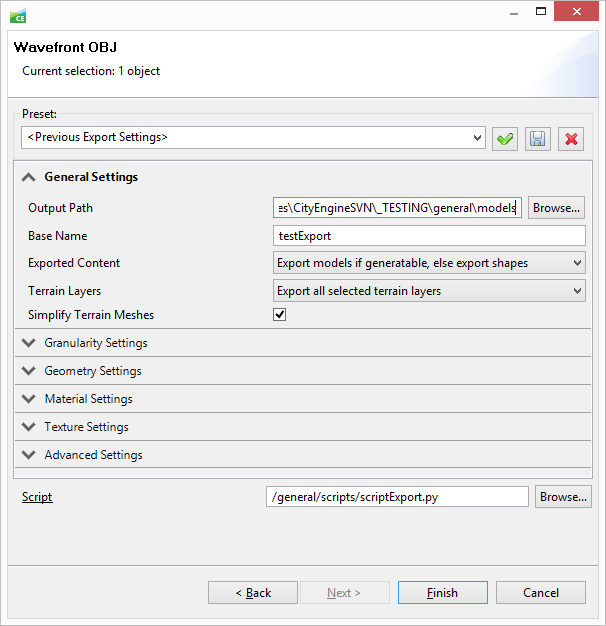
Example : Processing CGA report data
The following code snippet is a typical example of a CGA rule that reports data during generation.
FloorArea --> report("area", geometry.area)
Reported data can be accessed using the export callback functions.
The code below gives an example of how report data can be accessed and written to a file.
'''
Created on Nov 6, 2013

@author: andi
'''
from scripting import *

# Get a CityEngine instance
ce = CE()

REPORT = ""

def initExport(exportContextOID):
    global REPORT
    REPORT = "Name,#Floors,totalFloorArea,averageFloorArea\n"

def finishModel(exportContextOID, shapeOID, modelOID):
    shape = Shape(shapeOID)
    model = Model(modelOID)

    global REPORT
    i = 0
    totalArea = 0.0
    reports = model.getReports()
    if 'area' in reports.keys():
        for area in reports['floorArea']:
            totalArea +=area
            i+=1
        REPORT += "%s,%d,%f,%f\n" % (ce.getName(shape), i, area, area/i)
    else :
        REPORT += "%s,%d,%f,%f\n" % (model, 0, 0, 0)

def finishExport(exportContextOID):
    filename = ce.toFSPath("models/"+"/reportdata.txt")
    FILE = open(filename, "w")
    FILE.write(REPORT)
    FILE.close()
In this case, the resulting comma-separated file contains the following data:
| Name | #Floors | totalFloorArea | avgFloorArea |
|---|---|---|---|
LotSouth_35 | 5 | 357.3825 | 71.47651 |
LotSouth_37 | 4 | 335.8072 | 83.95179 |
LotSouth_38 | 3 | 379.4594 | 126.4865 |
... | ... | ... | ... |
Specific methods in callback functions
These Python methods only work in callback functions
| method | description |
|---|---|
returns dict of CGA report() data | |
returns tuple of local/global export offsets |
Checking Module Name
To prevent code outside the callback methods from being executed when the exporter calls the script, the module attribute __name__ can be used to distinguish the caller.
if __name__ == '__main__':
    #only do stuff is script is started directly
This allows to have a script that can both be used for normal Python exection as well as for script-based export, e.g.
def finishModel(exportContextOID, shapeOID, modelOID):
    # export callback code

if __name__ == '__main__':
    exportSettings = OBJExportModelSettings()
    exportSettings.setScript("/general/scripts/scriptbasedexport.py")
    ce.export(ce.selection(), exportSettings)
In the example above the main clause will not be executed when the script is called by the script-based exporter
Module names in different contexts
Resulting module name __name__ in different contexts:
| Context | Module Name |
|---|---|
context is being run by itself | __main__ |
context is started from exporter | __export__ |
context is started on startup procedure | __startup__ |
See also